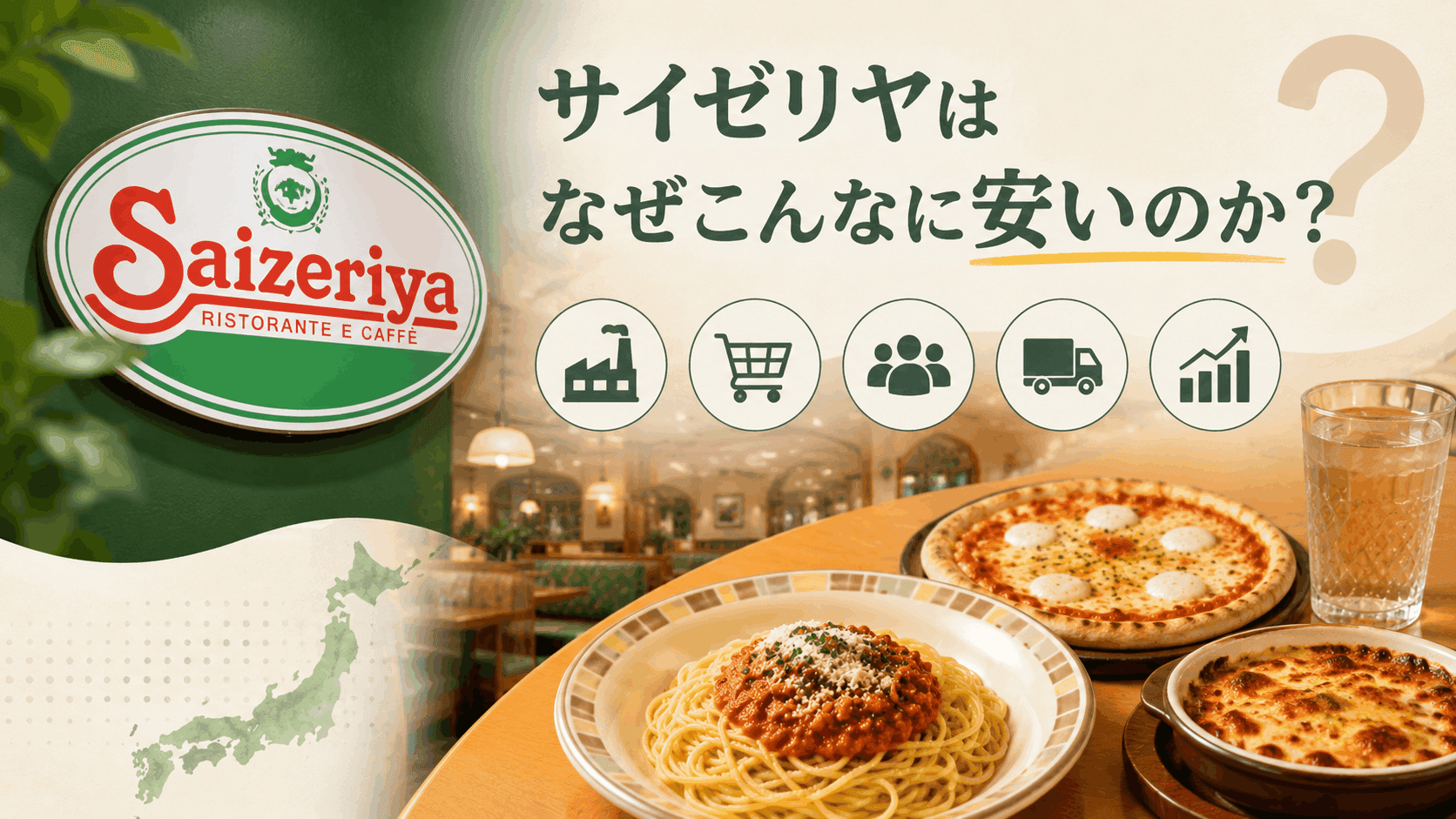
Why does Saizeriya in Japan always keep its prices low?
Why is Saizeriya in Japan so cheap?
It’s the weekend, so I took my wife and daughter out to eat at Saizeriya. Not our first time either—there’s a branch near our place, so whenever we don’t know what to eat or feel too tired to cook, we end up dropping by as a family.
While we were eating, my wife asked me a pretty interesting question:
Do you know why Saizeriya is always so reasonably priced?
I answered with something vague like, “They probably make a lot of sales, so their prices are lower.”
But once I got home, I got curious and spent some time looking into Saizeriya’s financial reports and analyses of their business model. Turns out that behind those pasta plates for around 300 yen is a highly organized operation.
What’s especially interesting is that even after keeping prices low for years, Saizeriya still brings in over 25 billion yen in revenue every year—and profits keep growing. In my view, there are five key reasons.
1. They don’t run like a traditional restaurant
Many people assume Saizeriya’s prices are low because they can buy ingredients cheaply. In reality, the biggest difference is how they standardize everything—almost like a production factory.
Most of the sauces, meats, and ingredients are pre-processed at factories before being shipped to the stores. That means staff only need to finish the dish in a few minutes, so they don’t need many highly specialized chefs.
As a result, labor costs drop, the kitchen can be smaller, and the quality of the meals is nearly the same across all locations.
2. Low margin, but they sell a lot
When ingredient prices rise, most restaurants simply raise their menu prices. Saizeriya does the opposite.
They accept lower profit on each dish to keep prices attractive, which draws in more customers. The higher customer volume boosts revenue and spreads fixed costs across more bills.
In simple terms, instead of trying to make a huge amount of money from a single customer, Saizeriya focuses on serving lots of customers at an easy-to-reach price.
3. Optimizing every last yen of cost
If you’ve visited Saizeriya recently, you may have noticed their operations are already quite automated:
Ordering by QR code.
Paying with an automatic machine.
Simplified service flow.
Because staff don’t spend much time taking orders or processing payments, they can focus on preparing the dishes, bringing them to tables, and clearing up.
Even the menu is designed quite smartly: many dishes share common ingredients like sauce, cheese, or minced meat. This helps them buy in bulk, reduces inventory buildup, and cuts down on waste.
4. Make the most of each store
A store generates revenue only when customers are seated. So instead of only thinking about raising prices, Saizeriya looks for ways to increase the number of customer visits throughout the day.
They’ve tested breakfast menus in some areas, adjusted dishes according to the seasons, and improved service speed to increase table turnover.
The more often tables are used in a day, the lower the rent cost per customer becomes.
5. A supply chain they control themselves
Saizeriya doesn’t rely entirely on outside suppliers. They operate their own factory systems and processing centers in Japan as well as overseas.
Having control from raw ingredients to processing allows the company to manage quality, portioning, and costs more effectively. This is a major advantage when food prices fluctuate in the market.
Conclusion
After researching, the most interesting thing to me is that Saizeriya doesn’t make money by selling a single plate of pasta at a very high price.
Instead, they earn money by optimizing almost every step behind the scenes—factories, logistics, the menu, all the way to the service process.
Maybe that’s why, even as prices in Japan keep rising, Saizeriya remains a go-to option for many families, students, and working adults.
It’s also a good example showing that companies don’t necessarily need to raise prices to increase profits. Sometimes, keeping prices low while operating more efficiently is a far more effective strategy.

![[2026] Rakuten Shopping Marathon 09/05 – 16/05: Tips to grab deals and optimize points when shopping on Rakuten](/_next/image?url=%2Fuploads%2Farticles%2F1778861120750-l2qia9hubrs.png&w=3840&q=75)